Algorithmic Design and Techniques
Table of contents
- Programming challenges
- Algorithmic warm-up
- Greedy algorithm
- Divide-and-conquer
- Dynamic Programming 1
- Dynamic Programming 2
Programming challenges
Document: pdf
Algorithmic warm-up
Document: pdf
Fibonacci numbers
Definition: \(F_n=\begin{cases} 0 & n=0\\ 1 & n=1\\ F_{n-1}+F_{n-2} & n>1 \end{cases}\)
Naive algorithm:
def FibRecurs(n):
    if n <= 1:
        return n
    else:
        return FibRecurs(n-1) + FibRecurs(n-2)
Running time: let $T(n)$ denote the number of lines of code executed by program. So \(T(n)=\begin{cases} 2 & n\le 1\\ T(n-1) + T(n-2)+3 & n>1 \end{cases}\) If $n=0,1, T(n)=2>1=F_1>F_0$. If $T(n-1)\ge F_{n-1}$ and $T(n-2)\ge F_{n-2}$, then \(T(n)=T(n-1) + T(n-2)+3\ge F_{n-1}+F_{n-2}+3>F_n\) By induction, $T(n)\ge F_n$. This is not acceptable! We keep computing the same $F_n$ again and again, that’s why the algorithm is very slow.
def FibList(n):
    create an array F[0,...,n]
    F[0] <- 0
    F[1] <- 1
    for i from 2 to n:
        F[i] <- F[i-1] + F[i-2]
    return F[n]
$T(n)=2n+2$.
Greatest common divisor (GCD)
Thought: $a=a’+bq$ for some $q$, so $d$ divides $a,b$ iff it divides $a’,b$.
Lemma: gcd(a,b) = gcd(a',b) = gcd(b,a')
def EuclidGCD(a,b):
    if b=0:
        return a
    a' <- the remainder when a is divided by b
    return EuclidGCD(b,a')
For least common multiplier (lcm), a * b = gcd(a,b) * lcm(a,b). Use // for integer divisor, or there would be precision problem when numbers are large.
Big O notation
Definition: $ f(n)=O(g(n))(f $ is Big-O of $ g) $ or $ f \preceq g $ if there exist constants $ N $ and $ c $ so that for all $ n \geq N, f(n) \leq c \cdot g(n) $.
Clarifies growth rate: we care how much runtime scale with input size
Common Rules
- Multiplicative constants can be omitted: $7 n^{3}=O\left(n^{3}\right), \frac{n^{2}}{3}=O\left(n^{2}\right)$
- $n^{a} \prec n^{b}$ for $0 < a < b$: $n=O\left(n^{2}\right), \sqrt{n}=O(n)$
- $n^{a} \prec b^{n}(a>0, b>1)$: $n^{5}=O\left(\sqrt{2}^{n}\right), n^{100}=O\left(1.1^{n}\right)$
- $(\log n)^{a} \prec n^{b}(a, b>0)$: $(\log n)^{3}=O(\sqrt{n}), n \log n=O\left(n^{2}\right)$
Smaller terms can be omitted : \(n^{2}+n=O\left(n^{2}\right), 2^{n}+n^{9}=O\left(2^{n}\right)\) Consider Fibonacci numbers,
for i from 2 to n:
    F[i] <- F[i-1] + F[i-2]
This should be $O(n^2)$. Addition between two very large numbers is $O(n)$.
For functions $ f, g: \mathbb{N} \rightarrow \mathbb{R}^{+} $we say that:
- $ f(n)=\Omega(g(n)) $ or $ f \succeq g $ if for some $ c $, $ f(n) \geq c \cdot g(n) $ ( $ f $ grows no slower than $ g) $.
- $ f(n)=\Theta(g(n)) $ or $ f \asymp g $ if $ f=O(g) $ and $ f=\Omega(g) $ ( $ f $ grows at the same rate as $ g) $.
- For functions $ f, g: \mathbb{N} \rightarrow \mathbb{R}^{+} $we say that: $f(n) = o(g(n))$ or $f \prec g$ if $f(n)/g(n) \to 0$ as $n \to \infty (f \text{ grows slower than } g)$.
Pisano period
The modulus of Fibonacci numbers is periodic, the period of mod $m$ is called Pisano period ($P_m$). In order to get $F_n \mod m$, first let n <- n % P_m, then apply naive algorithm.
# Uses python3
def pisano_period(m):
    previous, current = 0, 1
    for i in range(m*m):
        previous, current = current, (previous + current) % m

        if (previous == 0) and (current == 1):
            return i + 1

def get_fibonacci_huge_naive(n, m):
    previous, current = 0, 1

    n = n % pisano_period(m)

    if n <= 1:
        return n
    else:
        for _ in range(n - 1):
            previous, current = current, (previous + current)

    return current % m
Sum of Fibonacci numbers
Property: \(S_n = F_0 + F_1 + \dots + F_n = F_{n+2} - 1\) This can be easily proved by induction.
Greedy algorithm
Document: pdf
Definition: Subproblem is a similar problem of smaller size. A greedy choice is called safe choice if there is an optimal solution consistent with this first choice.
In the patient queue problem, safe choice is: the patient with treatment time $t_{\min}$ is the first.
MinTotalWaitingTime(t,n)
waitingTime <- 0
treated <- array of n zeros
for i from 1 to n:
    t_min <- +infty
    minIndex <- 0
    for j from 1 to n:
        if treated[j] == 0 and t[j] < t_min:
            t_min <- t[j]
            minIndex <- j
    waitingTime <- waitingTime + (n-i) * t_min
    treated[minIndex] = 1
return waitingTime
The runtime of MinTotalWaitingTime(t,n) is $O(n^2)$, but this problem can be solved in $O(n\log n)$.
General strategy:
- Make a greedy choice
- Prove that it is a safe choice
- Reduce to a subproblem
- Solve the subproblem
Celebration party problem
Divide children into groups, each group with age difference smaller than 2 years, what’s the minimum number of groups?
Let $x_1,\cdots,x_n$ be all children’s ages, think of a group of an interval with length 2. The safe choice is let the left edge start at the minimum $x_j,j\ge 1$, and remove the points included in the interval.
Assume $x_1\le x_2\le\cdots\le x_n$,
def PointsCoverSorted(x1,...,xn):
    segments <- empty list
    left <- 1
    while left <= n:
        (l, r) <- (x_left, x_left+2)
        segments.append((l, r))
        left <- left + 1
        while left <= n and x_left <= r:
            left <- left + 1
    return segments
PointsCoverSorted works in $O(n)$, later sorting is $O(n\log n)$, so Sort + PointsCoverSorted is $O(n\log n)$.
Maximizing Loot
Problem:
- Input: Weights $w_1,\cdots,w_n$ and values $v_1,\cdots,v_n$ of $n$ items; capacity $W$.
- Output: The maximum total value of fractions of items that fit into a knapsack of capacity $W$.
def BestItem(w1,v1,...wn,vn):
    maxValuePerWeight <- 0
    bestItem <- 0
    for i from 1 to n:
        if w_i > 0:
            if v_1 / w_i > maxValuePerWeight:
                maxValuePerWeight <- v_1 / w_i
                bestItem <- i
    return bestItem

def Knapsack(W,w1,v1,...,wn,vn):
    amounts <- [0,0,...,0]
    totalValue <- 0
    for _ in range(n):
        if W = 0:
            return (totalValue, amounts)
        i <- BestItem(w1,v1,...,wn,vn)
        a <- min(w_i, W)
        totalValue <- totalValue + a * v_i / w_i
        w_i <- w_i - a
        amounts[i] <- amounts[i] + a
        W <- W - a
    return (totalValue, amounts)
The running time of Knapsack is $O(n^2)$. If first sort $v_i/w_i$. Assume $v_1/w_1\ge\cdots\ge v_n/w_n$.
def KnapsackFast(W,w1,v1,...,wn,vn):
    amounts <- [0,0,...,0]
    totalValue <- 0
    for i in range(n):
        if W = 0:
            return (totalValue, amounts)
        # i <- BestItem(w1,v1,...,wn,vn)
        a <- min(w_i, W)
        totalValue <- totalValue + a * v_i / w_i
        w_i <- w_i - a
        amounts[i] <- amounts[i] + a
        W <- W - a
    return (totalValue, amounts)
KnapsackFast itself is $O(n)$, sorting is $O(n\log n)$.
Python implementation:
def get_optimal_value(capacity, weights, values):
    value = 0.
    # write your code here
    n = len(weights)
    items = [(values[i] / weights[i], values[i], weights[i]) for i in range(n)]
    items.sort(key=lambda x: x[0], reverse=True)

    for ratio, v, w in items:
        if capacity == 0:
            break
        a = min(capacity, w)
        value += ratio * a
        capacity -= a

    return value
Collecting Signatures
Problem introduction:
You are responsible for collecting signatures from all tenants of a certain building. For each tenant, you know a period of time when he or she is at home. You would like to collect all signatures by visiting the building as few times as possible. The mathematical model for this problem is the following. You are given a set of segments on a line and your goal is to mark as few points on a line as possible so that each segment contains at least one marked point.
Task: Given a set of $ n $ segments \(\left\{\left[a_{0}, b_{0}\right],\left[a_{1}, b_{1}\right], \ldots,\left[a_{n-1}, b_{n-1}\right]\right\}\) with integer coordinates on a line, find the minimum number $ m $ of points such that each segment contains at least one point. That is, find a set of integers $ X $ of the minimum size such that for any segment $ \left[a_{i}, b_{i}\right] $ there is a point $ x \in X $ such that $ a_{i} \leq x \leq b_{i} $.
Procedure:
- Sort the end of each segment from small to large: $[a_{\pi(1)}, b_{\pi(1)}], [a_{\pi(2)}, b_{\pi(2)}], \dots, [a_{\pi(n)}, b_{\pi(n)}]$, where $b_{\pi(1)} \leq b_{\pi(2)} \leq \dots \leq b_{\pi(n)}$.
- Initialize $X=\varnothing$.
- Iterate:
- If $x\in [a_{\pi(k)}, b_{\pi(k)}]$ and $x\in X$, do nothing
- Otherwise, add new $x=b_{\pi(k)}$ into $X$
Python implementation:
Segment = namedtuple('Segment', 'start end')

def optimal_points(segments):
    points = []
    segments.sort(key=lambda s: s.end)
    currentPoint = None
    for s in segments:
        if currentPoint is None or not (s.start <= currentPoint <= s.end):
            currentPoint = s.end
            points.append(currentPoint)

    return points
Maximum Number of Prizes
Problem description
Task. The goal of this problem is to represent a given positive integer $ n $ as a sum of as many pairwise distinct positive integers as possible. That is, to find the maximum $ k $ such that $ n $ can be written as $ a_{1}+a_{2}+\cdots+a_{k} $ where $ a_{1}, \ldots, a_{k} $ are positive integers and $ a_{i} \neq a_{j} $ for all $1 \le i < j \le k$.
Python implementation:
def optimal_summands(n):
    summands = []
    currentPrize = 1

    for i in range(n):
        if 2 * currentPrize + 1 <= n - sum(summands):
            summands.append(currentPrize)
            currentPrize += 1
        else:
            summands.append(n - sum(summands))
            break

    return summands
Test result
Different Summands:
Good job! (Max time used: 4.05/5.00, max memory used: 11403264/536870912.)
Remember that command sum is $O(n)$. Now replace sum with a tracking variable total,
def optimal_summands(n):
    summands = []
    currentPrize = 1
    total = 0

    for i in range(n):
        if 2 * currentPrize + 1 <= n - total:
            summands.append(currentPrize)
            total += currentPrize
            currentPrize += 1
        else:
            summands.append(n - total)
            break

    return summands
Test result
Different Summands:
Good job! (Max time used: 0.05/5.00, max memory used: 11411456/536870912.)
Maximum Salary
Previously, the algorithm in lecture works only in case the input consists of single-digit numbers. For example, for an input consisting of two integers $23$ and $3$ ($23$ is not a single-digit number!) it returns $233$ , while the largest number is in fact $323$ . In other words, using the largest number from the input as the first number is not a safe move.
Your goal in this problem is to tweak the above algorithm so that it works not only for single-digit numbers, but for arbitrary positive integers.
from functools import cmp_to_key

def largest_number(a):
    def _cmp(x, y):
        if x + y < y + x: return -1
        elif x + y > y + x: return 1
        else: return 0
    a = sorted(map(str, a), key=cmp_to_key(_cmp), reverse=True)
    res = ""
    for x in a:
        res += x
    return res
Details for cmp_to_key see Codecademy.
Divide-and-conquer
Document: pdf
Linear search
LinearSearch(A, low, high, key)
    if high < low:
        return NOT_FOUND
    if A[low] = key:
        return low
    return LinearSearch(A, low+1, high, key)
The runtime is $\sum_{i=1}^n c=\Theta(n)$.
Consider a sorted array $A$, from smallest to largest order.
Binary search
$n,n/2,n/4,\cdots, 2, 1,0$, complexity is $\sum_{i=0}^{\log_2 n}c=\Theta(\log_2 n)$. Verify: $2^{\log_2 n}=n.$
Python implementation:
def binary_search(a: list, x: int) -> int:
    left, right = 0, len(a)-1
    # write your code here
    while left <= right:
        mid = (left + right) // 2
        if a[mid] == x:
            return mid
        elif x > a[mid]:
            left = mid + 1
        else:
            right = mid - 1
    return -1
Master theorem
If $T(n)=aT(\lfloor n/b\rfloor)+O(n^d)$, for constraints $a>0,b>1,d\ge 0$, then
- If $d>\log_b a, T(n)=O(n^d)$
- If $d=\log_b a, T(n)=O(n^d\log n)$
- If $d<\log_b a, T(n)=O(n^{\log_b a})$
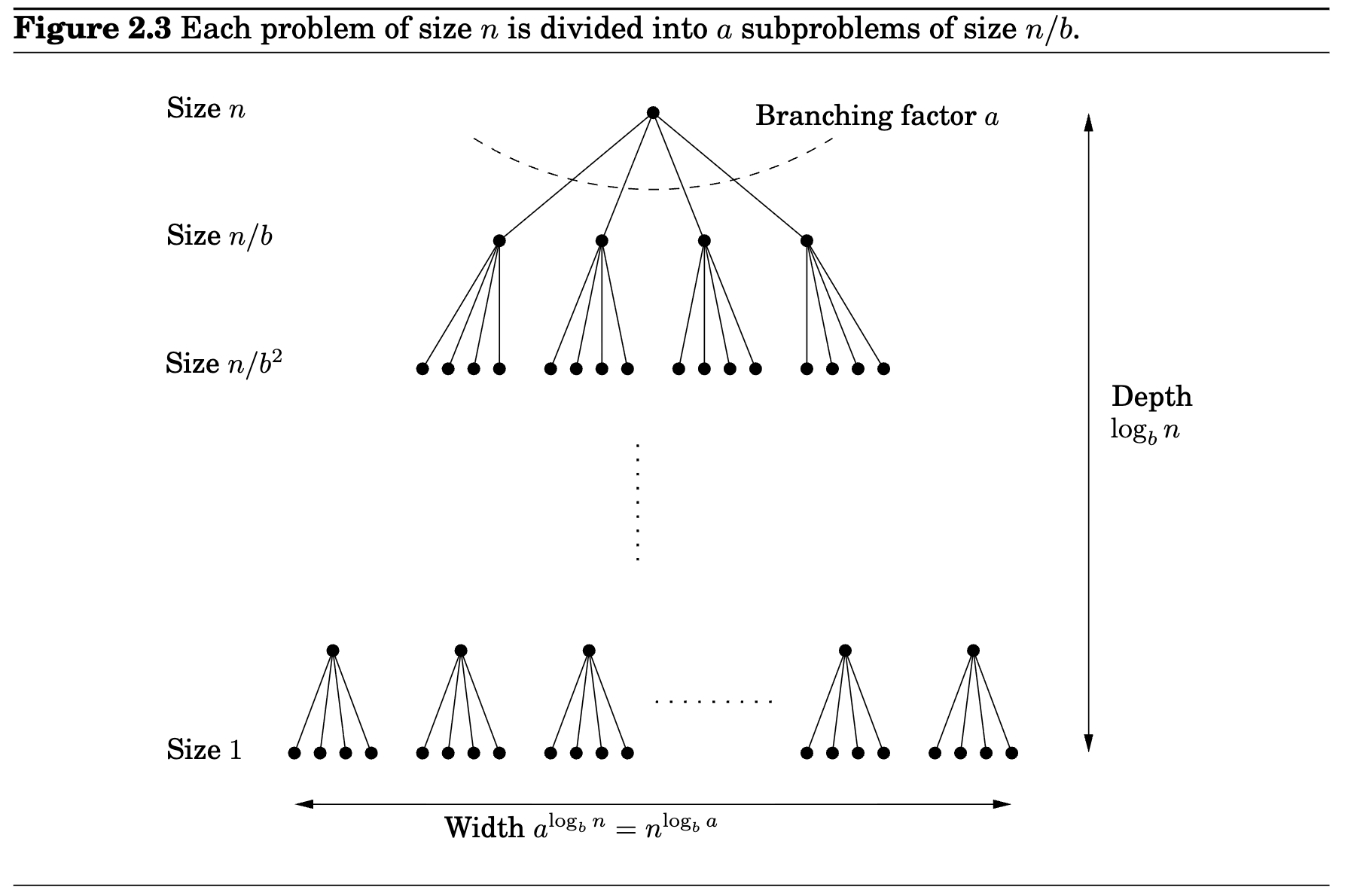
Proof: The amount of work at level $i$ is $a^i O(n/b^i)^d=O(n^d)(a/b^d)^i$. The total work is $\sum_{i=0}^{\log_b n}O(n^d)(a/b^d)^i$.
- When $a/b^d<1$ or $d>\log_b a,$ \(\sum_{i=0}^{\log_b n}O(n^d)(a/b^d)^i=O(n^d)\)
- When $a/b^d=1$ or $d=\log_b a,$ \(\sum_{i=0}^{\log_b n}O(n^d)(a/b^d)^i=\sum_{i=0}^{\log_b n}O(n^d)=(1+\log_b n)O(n^d)=O(n^d\log n)\)
- When $a/b^d>1$ or $d<\log_b a,$ \(\sum_{i=0}^{\log_b n}O(n^d)(a/b^d)^i=O\bigg(O(n^d)(\frac{a}{b^d})^{\log_b n}\bigg)=\bigg(O(n^d)(\frac{n^{\log_b a}}{n^d})\bigg)=O(n^{\log_b a})\)
Majority element
Majority rule is a decision rule that selects the alternative which has a majority, that is, more than half the votes. Given a sequence of elements $ a_{1}, a_{2}, \ldots, a_{n} $, you would like to check whether it contains an element that appears more than $ n / 2 $ times.
def get_majority_element(a, left, right):
    if left == right:
        return -1
    if left + 1 == right:
        return a[left]
    #write your code here
    mid = (left + right) // 2
    m1 = get_majority_element(a, left, mid)
    m2 = get_majority_element(a, mid, right)
    if m1 == m2:
        return m1
    else:
        count1 = sum(1 for i in range(left, right) if a[i] == m1)
        count2 = sum(1 for i in range(left, right) if a[i] == m2)
        if count1 > (right - left) // 2:
            return m1
        elif count2 > (right - left) // 2:
            return m2

    return -1
If enter
5
2 3 9 2 2
The step-by-step picture will be
[0,5): [2,3,9,2,2], mid=2 → result = 2
├── [0,2): [2,3], mid=1 → result = -1
│   ├── [0,1): [2] → 2
│   └── [1,2): [3] → 3
└── [2,5): [9,2,2], mid=3 → result = 2
    ├── [2,3): [9] → 9
    └── [3,5): [2,2], mid=4 → 2
        ├── [3,4): [2] → 2
        └── [4,5): [2] → 2
Selection sort
for i from 1 to n:
    minIndex <- i
    for j from i+1 to n:
        if A[j] < A[minIndex]:
            minIndex <- j
    {A[minIndex] = min A[i,...,n]}
    swap(A[i], A[minIndex])
    {A[1,...,i] is in final position}
Runtime is $O(n^2)$. Pf: $1+2+\cdots+n=n(n+1)/2$.
Other quadratic time sorting algorithms include insertion sort, bubble sort.
Merge sort
def MergeSort(A[1,...,n]):
    if n=1:
        return A
    m <- n//2
    B <- MergeSort(A[1,...,m])
    C <- MergeSort(A[m+1,...,n])
    A' <- Merge(B,C)
    return A'

def Merge(B[1,...,p], C[1,...,q]):
    {B and C are sorted}
    D <- empty array of size p+q
    while B and C are both non-empty:
        b <- the first element of B
        c <- the first element of C
        if b <= c:
            move b from B to the end of D
        else:
            move c from C to the end of D
    move the rest of B or C to the end
    return D
The runtime of MergeSort is $O(n\log n)$. Pf: The runtime of merging is $O(n)$, at most $p+q$ steps are taken to merge B and C. So MergeSort has $T(n)\le 2T(n/2)+O(n)$, then use master theorem.
Exercise: [4-4] Count inversions
Comparison based sorting
Selection sort and merge sort are both comparison based.
Lemma: Any comparison based sorting algo performs $\Omega(n\log n)$ comparisons in the worst case to sort $n$ objects.
Pf: Divide-and-conquer can be considered as a tree with leaves. # of leaves $l$ is at least $n!$, the depth of tree is $d$, then $2^d\ge l\Longrightarrow d\ge \log_2 l$. Thus the runtime is at least $\log_2(n!)\approx \log_2 (\sqrt{2\pi}n^{n+1/2}e^{-n})=\Omega(n\log n)$.
Count sort
Count[1...M] ← [0,...,0]
for i from 1 to n:
    Count[A[i]] ← Count[A[i]] + 1
{k appears Count[k] times in A}
Pos[1...M] ← [0,...,0]
Pos[1] ← 1
for j from 2 to M:
    Pos[j] ← Pos[j−1] + Count[j−1]
{k will occupy range [Pos[k],...,Pos[k+1]-1]}
{or say k starts from index Pos[k]}
for i from 1 to n:
    A′[Pos[A[i]]] ← A[i]
    Pos[A[i]] ← Pos[A[i]] + 1
with complexity $O(n+M)$. Count Sort can only be applied to integer numbers: real numbers cannot play the role of indices of an array.
Quick sort
def Partition(A,l,r):
    x <- A[l]  {pivot}
    j <- l
    for i from l+1 to r:
        if A[i] <= x:
            j <- j + 1
            swap A[j] and A[i]
        {A[l+1,...,j] <= x, A[j+1,...,i] > x}
    swap A[l] and A[j]
    return j

def RandomizedQuickSort(A,l,r):
    if l >= r:
        return
    k <- random number between l and r
    swap A[l] and A[k]
    m <- Partition(A,l,r)
    {A[m] is in the final position}
    RandomizedQuickSort(A,l,m-1)
    RandomizedQuickSort(A,m+1,r)
A nice animation on this.
Efficiency decreases when the split happens unbalancedly. Two cases:
- always pick pivot from the edge (use random pivot)
- dealing with data that have few unique values (use
Partition3)
Design $(m_1,m_2)\leftarrow \text{Partition3}(A,l,r)$, such that
- for all $l\le k\le m_1-1,A[k]< x$
- for all $m_1\le k\le m_2,A[k]= x$
- for all $m_1+1\le k\le r,A[k]> x$
Exercise: [4-3] Partition3.
Dynamic Programming 1
Document: pdf
Money change revisited. This time greedy algo cannot give a safe choice. DP can fix it.
Money change and Primitive calculator are a kind of DP problem.
def optimal_sequence(n):
    v = [float('inf')] * (n + 1)
    v[1] = 0
    for i in range(1, n + 1):
        if i + 1 <= n and v[i + 1] > v[i] + 1:
            v[i + 1] = v[i] + 1
        if i * 2 <= n and v[i * 2] > v[i] + 1:
            v[i * 2] = v[i] + 1
        if i * 3 <= n and v[i * 3] > v[i] + 1:
            v[i * 3] = v[i] + 1

    # backtrack optimal path
    path = [n]
    cur = n
    while cur > 1:
        if cur % 3 == 0 and v[cur // 3] == v[cur] - 1:
            cur //= 3
        elif cur % 2 == 0 and v[cur // 2] == v[cur] - 1:
            cur //= 2
        else:
            cur -= 1
        path.append(cur)
    path.reverse()
    return path
First Bottom-up, then Top-down.
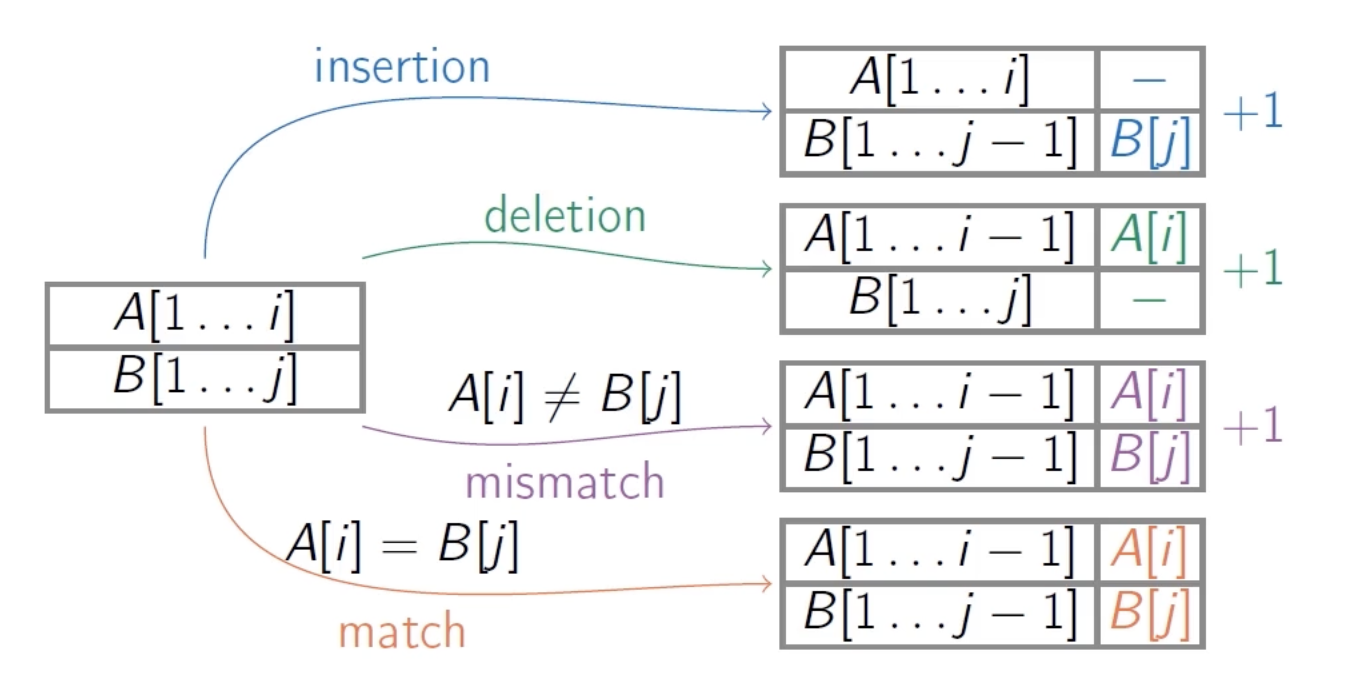
Edit distance is another kind.
Dynamic Programming 2
Document: pdf
Knapsack
knapsack
├── fractional knapsack -> greedy algo
└── discrete knapsack -> greedy does not work!
    ├── with repetitions (unlimited quantities)
    └── without repetitions (one of each item)
Knapsack revisited. Last time we used greedy algo for fractional knapsack. But it doesn’t work for discrete knapsack. Again, DP can fix it. It seems DP is a broader category that can apply to situations when greedy algo is not valid.
Knapsack with repetitions
value(0) <- 0
for w from 1 to W:
    value(w) <- 0
    for i from 1 to n:
        if w_i <= w:
            val <- value(w-w_i) + v_i
            if val > value(w):
                value(w) <- val
return value(W)
Knapsack without repetitions
Subproblems: For $ 0 \leq w \leq W $ and $ 0 \leq i \leq n, \operatorname{value}(w, i) $ is the maximum value achievable using a knapsack of weight $ w $ and items $ 1, \ldots, i $.
The $ i $-th item is either used or not: value $ (w, i) $ is equal to \(\max \left\{\text { value }\left(w-w_{i}, i-1\right)+v_{i}, \text { value }(w, i-1)\right\}\)
init all value(0, j) <- 0
init all value(w, 0) <- 0
for i from 1 to n:
    for w from 1 to W:
        value(w, i) <- value(w, i-1)
        if w_i <= w:
            val <- value(w-w_i, i-1) + v_i
            if value(w, i) < val:
                value(w, i) <- val
return value(W, n)
Remark
DP question starts from finding the correct subproblem. Then solve subproblem by solving sub-sub-problem. This recurrence relation can be transformed into
- iterative algorithm
- solve all subproblems from smaller to bigger ones. (bottom up)
- recursive algorithm
- make recursive calls to smaller subsubproblems
Recursive algo can be slow because they compute same thing again and again (e.g. Fibonacci). But here’s a simple technique called memoization: when solving a sub-problem, you store the result in a table.
Usually iterative algorithm is faster.
The running time $O(nW)$ is not polynomial, since $W$ is not the size of input but the value of input. Input size is measured in bits. If $W=10^6$, in binary, $W$ takes $\log_2(10^6)=6$ bits. So the input length includes:
- $n$ items: $O(n)$
- weights and values, each encoded in $O(\log W)$ bits
In other words, the running time is $O(n 2^{\log W})$.
Placing parentheses
Let $E_{i,j}$ be the subexpression $d_i\ op_i\ \cdots op_{j-1}\ d_j$. Subproblem is, let $M(i,j)$ be the max value of $E_{i,j}$, and $m(i,j)$ be the min value of $E_{i,j}$. \(\begin{array}{l}\displaystyle M(i, j)=\max_{i \leq k \leq j-1}\left\{\begin{array}{lll}M(i, k) & o p_{k} & M(k+1, j) \\ M(i, k) & o p_{k} & m(k+1, j) \\ m(i, k) & o p_{k} & M(k+1, j) \\ m(i, k) & o p_{k} & m(k+1, j)\end{array}\right. \quad m(i, j)=\min_{i \leq k \leq j-1}\left\{\begin{array}{lll}M(i, k) & o p_{k} & M(k+1, j) \\ M(i, k) & o p_{k} & m(k+1, j) \\ m(i, k) & o p_{k} & M(k+1, j) \\ m(i, k) & o p_{k} & m(k+1, j)\end{array}\right.\end{array}\)
def MinAndMax(i,j):
    min <- +infty
    max <- -infty
    for k from i to j-1:
        a <- M(i,k) op_k M(k+1,j)
        b <- M(i,k) op_k m(k+1,j)
        c <- m(i,k) op_k M(k+1,j)
        d <- m(i,k) op_k m(k+1,j)
        min <- min(min, a, b, c, d)
        max <- max(max, a, b, c, d)
    return (min, max)

def Parentheses(d1, op1, d2, op2, ..., dn):
    for i from 1 to n:
        m(i,i) <- di, M(i,i) <- di
    for s from 1 to n-1:
        for i from 1 to n-s:
            # s=1 -> i=1:(n-1), s=n-1 -> i=1
            j <- i + s
            # keep j-i=s
            min(i,j), M(i,j) <- MinAndMax(i,j)
    return M(1,n)